


The Psychological Culture in Christianity

This is an important post. If some Christians are real enough to realize that many of their beliefs are noxious, they will be happier and safer, and so will their children, and the world will be a better place.
Suppression, Greed and Hypocrisy
People in Churches not only buy into Biblical belief, but bow down to those pushing it too. Christianity is, and always has been, a power game.
 Priests, pastors, and other preachers, claiming to orate with God’s authority, often assume they are the arbiters of people’s lives. For no rational reason, but just tradition, people in Churches accept their authority. These Church leaders take on the role of life coaches, and they are usually gratified by the status that gives them. They are often egotists who revel in being admired and listened to, and are out to feather their own nests rather than really help people. Their first focus is usually not on furnishing happiness for others, but on procuring power, adulation and cash. They have bought into the Christian franchise, and that means they need to push a dubious product, the Bible, for their own and maybe their institution’s gain. The Bible is full of faults and nonsense, but it is too risky for them to preach too much that is novel. Most of the Bible can be ignored and all of it can be “interpreted,” so they make the most of the cards they have been dealt.
![46732233_7539c400e9[1]](http://www.markfulton.org/wp-content/uploads/2011/06/46732233_7539c400e91-300x225.jpg) Many preachers are poorly qualified for the job of a “life coach.” Bible school, or whatever its equivalent may be, is hardly a solid platform from which to preach morality, ethics and coping skills. One could hardly start from a more unsound base! There is usually no knowledge of psychology, medicine, or counseling required to be a preacher, but that often does not matter too much.
Many preachers are poorly qualified for the job of a “life coach.” Bible school, or whatever its equivalent may be, is hardly a solid platform from which to preach morality, ethics and coping skills. One could hardly start from a more unsound base! There is usually no knowledge of psychology, medicine, or counseling required to be a preacher, but that often does not matter too much.
A few unsatisfied punters in a congregation may leave, but for the typical preacher it is the money coming in that is the most important thing.
The typical Church service has a
“the answers everyone needs are right here”
perspective. This is a rigid, flawed approach, because it is a one-way dialogue that ignores a person’s individuality. When someone needs general advice or has personal problems, a good counselor must first listen and ask questions before suggesting possible solutions. That rarely happens in a Church.
 There is no worthwhile advice a “man of God” can offer people that cannot be better given by an experienced, appropriately trained humanitarian. What is more, the advice given by preachers is often profoundly wrong. Almost invariably they suggest to pray, or to read the Bible, or to suppress worldly aspirations, or to take a long-term view, or to just hope. Some of them quote Jesus.
“If you remain in me and my words remain in you, you may ask what you will and you will get it.” (John 15:7, NJB.)
“Happy you who weep now; you shall laugh” (Luke 6:21, NJB.)
“Rejoice and be glad, for your reward is great in heaven…” (Matt. 5:12, NJB.)
This is not helpful advice, it is oppression! Preachers use Jesus’ words to focus on the promise of eternal salvation, a pot of gold at the end of life’s rainbow, granted only to those special people who have faith. It is easy, if you are a preacher, to make promises you are never obliged to make come true.
From a preacher’s perspective, those people who do not buy the faith spiel are trouble causers and not real Christians – it is probably best they go somewhere else.
Some of these preachers are hypocrites. The vaunted love said to be a Christian characteristic is often not a part of their repertoire when people are in real trouble. Too often preachers find it easier to tell a punter they will be prayed for than do something concrete, but true love, or real empathy, is always more that just words.

Some preachers even advise avoidance of help from the secular world, which derails the pursuit of pragmatic answers. They are worried about outsiders treading on their turf, because it may make their advice look ordinary.
Preachers often portray themselves as warm, caring people, and some of them are. Yet beneath the facade most Church leaders hope that people behave like sheep. Sheep are subservient, easily scared, do not ask questions, do not think for themselves and are easily fleeced.  Churchmen profit most from wooing a congregation. The return is much higher than from counseling or otherwise helping individuals. They get the people groveling at the mute Jesus’ feet. Yet Jesus is just a priest’s sock puppet, so people are really bowing down to the priest, or the institution he represents. The master’s cold eyes stare down from the crucifix. The flock fails to figure out there is no point in pretending Jesus is their pal. A real friend talks, but Jesus has not uttered a word for nearly two thousand years. He cannot tell the p
 eople to stop wasting their time and being so servile, because he is dead.
Genuinely caring preachers often do not have the tools in their armory to help people in need, which must be a source of frustration for them. Their obsolete book is of no real help.
Sitting in a church, or asking for help from a preacher, or praying to Jesus, are usually surefire ways to not find real solutions to personal problems.
The Psychological Effects
Most scams take the victim’s money; Christianity does that too, but doubles the insult by harming psychological health.
It is hard to measure religiosity, awkward to assess psychological damage, and finicky to prove a causal relationship between the two, but despite this, many respected doctors and psychologists claim various mental health issues are caused by Christian beliefs.[1] [2] [3]
Believers often feel guilty about sex and imagine their own natural feelings are evil. They resent or are angry about sexual freedoms they see, or think they see, in the secular world.
Many are frightened of hell. Some are plagued by ambiguity and uncertainty, and are reluctant to accept help from outsiders.
Some are resigned, sad, have low self-esteem, and go through life just pretending to be happy. Mother Theresa, a most unfortunate and miserable woman, was a classic example.[4]
Many others are agitated and stressed.
Allow me to elaborate.
Poor Self-Esteem
 While humanists usually encourage people to be strong, resilient, autonomous, and assertive, people in Churches are usually told they must be subordinate to God, and that personal identity and self-esteem reside only in the relationship with Jesus. This was a recurrent theme in Paul’s writings:
“For if a man think himself to be something, when he is nothing, he deceiveth himself” (Gal. 6:3, KJV,) and
“Nay but, O man, who art thou that repliest against God? Shall the thing formed say to him that formed it, why hast thou made me thus? Hath not the potter power over the clay, of the same lump to make one vessel unto honor, and another unto dishonor?” (Rom. 9:20–21, KJV) and
“For I say, through the grace given unto me, to every man that is among you, not to think of himself more highly than he ought to think; but to think soberly, according as God hath dealt to every man the measure of faith” (Rom. 12:3, KJV.)
It can be argued that Paul tried to make people feel small to make himself, their connection with God, look big. He was desperate to control others, and many of today’s preachers are little different.
A commonly quoted part of scripture is
“Pride goeth before destruction, and an haughty spirit before a fall” (Prov. 16:18, KJV.)
People must not be proud or God will put them back in their place!
As a direct consequence of power plays in the Bible, many believers have a heartfelt, perhaps subconscious conviction that their thoughts, and therefore the essence of who they are, are at fault and inferior. This is particularly true for some women, who can have their self-esteem squashed by studying the Bible.
This degradation of the value of the individual’s intellect contrasts starkly with Aristotle’s humanist teaching that a healthy self-esteem, being the mean between undue humility and empty vanity, is necessary for a meaningful life.
Preachers claim people get “grace” from God. The family dog might wag his tail if patted, but pretend praise from an imaginary man in the sky cannot create real self-esteem, particularly in someone who has been repeatedly told they were born a sinner and are nothing without God.
I have been generalizing. Some progressive Christians stress the importance of self-esteem, and many preachers claim people are worthy and lovable. Yet they cannot deny that an integral part of their dogma is that Jesus died for people because they are so sinful. Nor can they disagree with the fact that the Bible is a one-way flow of instructions.
Christians should value their own power and individuality. All people are unique and precious, particularly if they decide to believe it. Individual’s intellects and ideals are real and valuable, and people do not need a God to love themselves or others.
Patronizing preachers often use the Bible to put people down, while pretending to lift them up, and usually disguise this power play with a veneer of benevolence. Christians should not let them do this.[5]
Thought and Emotion Suppression
 Biblical authors sometimes tried to suppress individualism, and freethinking.
“Casting down imaginations,” wrote Paul, “and every high thing that exalteth itself against the knowledge of God, and bringing into captivity every thought to the obedience of Christ” (2 Cor. 10:5, KJV.)
All thoughts not focused on obeying Christ were evil. How convenient for Paul, as his Christ was his creation! How appropriate for today’s preachers, who claim they speak for Christ.
Jesus claimed emotions such as anger or lust were sinful:
“Ye have heard that it was said of them of old time, Thou shalt not kill; and whosoever shall kill shall be in danger of the judgment: But I say unto you, That whosoever is angry with his brother without a cause shall be in danger of the judgment: and whosoever shall say to his brother, Raca, shall be in danger of the council: but whosoever shall say, Thou fool, shall be in danger of hell fire” (Matt. 5:21–22, KJV) and
“But I say unto you, that whosoever looketh on a woman to lust after her hath committed adultery with her already in his heart” (Matt. 5:28, KJV.)
God is said to know what you are thinking. Big brother is monitoring your very thoughts. Whoever wrote this was not content with laying down rules for behavior, he wanted to control people’s emotions too, so he had God threaten punishment for thought crime.
Emotions are natural; they help us make decisions and understand others. They are what they are, and are not bad or wrong.
Reliance on Faith
 Preachers propose that people can achieve anything through prayer. They often quote Jesus, who said,
“For verily I say unto you, That whosoever shall say unto this mountain, Be thou removed, and be thou cast into the sea; and shall not doubt in his heart, but shall believe that those things which he saith shall come to pass; he shall have whatsoever he saith. Therefore I say unto you, what things soever ye desire, when ye pray, believe that ye receive them, and ye shall have them” (Mark 11:23–24, KJV.)
Christian literature is full of dubious anecdotal stories about the power of prayer and faith. But prayers are never answered. To pray for help is, in fact, a disempowering, desperate and lazy response to a problem, and a very poor substitute for pursuing a rational solution.
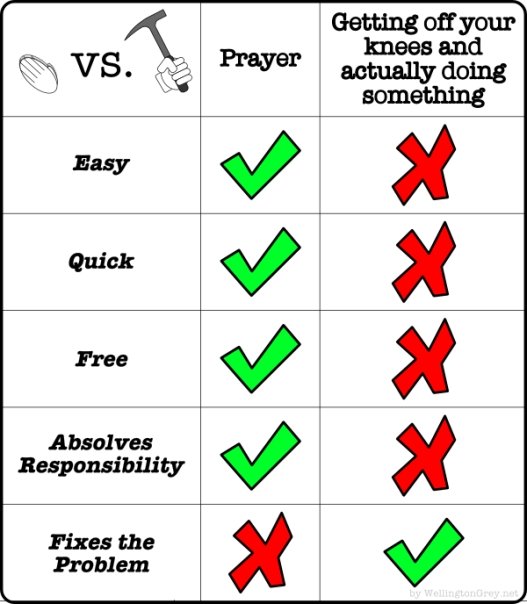

Consider an example; a preacher might proclaim
“Let’s pray for Mavis who has a fractured hip,” whereas a good secular humanist would say
“We are grateful that an orthopaedic surgeon has repaired Mavis’ fractured hip. She now needs our help. Let’s get her walking again, put handrails in her bathroom, improve her diet, and give her vitamin D. We do not want her to have another fracture.”
Paul wrote that Christ
“…always causes us to triumph” (2 Cor. 2:14, KJV.)
Why then cannot some Christians pass exams, find a job, a partner, lose weight or pay their bills?
We only triumph when we help ourselves, not when we grovel to an imaginary sky buddy. [6]
Children and the Burden of Shame
 Children in fundamentalist families are often regarded as little adults, with the same sinful tendencies, so Christian parents may not appreciate that children progress through stages of cognitive and emotional development. Childhood issues such as egocentrism, aggression, sexuality, and rebellion are labeled as sins, instead of natural, predictable problems. The “sin” is attributed to their innate nature; the child is made to feel ashamed, and is disciplined accordingly:
“You’re so selfish. What’s the matter with you? You know Jesus sees you when you do that!”
The child feels they are defective, bad, or a failure, and become filled with shame. Shame (in this sense) is more damaging than guilt, when we feel bad because of what we have done, not because of who we are. Shame takes a heavy toll on a child’s self-esteem, and often becomes a part of their psyche that persists into adulthood.
On the other hand, good parents know that poor behavior is usually a consequence of unmet needs, not a flawed nature, and is to be expected as part of a child’s natural development. They focus on addressing the child’s needs rather than wounding his or her ego.
Pretense
People are told that if they believe in Jesus they will be happy. If they are unhappy, it is often implied they do not have enough faith, so they need to work on their relationship with Jesus. As a consequence, many believers fail to admit their problems. They are so worried that other Christians will think Jesus is ignoring them, they do not get real help, so they just pretend everything is ok. Their life becomes a charade.
Christianity cultivates a culture of pretence, which is the antithesis of authenticity. To have a great life we need to be honest with each other, admit problems we have, express our emotions, and seek solutions, not from an imaginary celestial friend, but from our fellow man.
Fear of Hell
 Hell is one of the most evil aspects of Christianity. It means the hypothetical God figure is a sadistic, petulant, nasty dictator.
People are told that their current life will be judged in the next. The Purpose-Driven Life, written by Rick Warren, is a very popular book in Evangelical circles, with over 30 million copies sold. He writes,
“One day you will stand before God, and he will do an audit of your life, a final exam, before you enter eternity…he will ask us two crucial questions…First, ‘What did you do with my Son, Jesus Christ?’…Second, ‘What did you do with what I gave you?’…the second question will determine what you do in eternity…At the end of your life on earth you will be evaluated and rewarded according to how well you handled what God entrusted to you. That means everything you do…has eternal consequences.”
Imagine how that affects people’s peace of mind! Who needs this sort of “purpose?” [7]
Rick Warren sourced the idea of a judgmental God directly from the noxious Paul:
“For we must all appear before the judgment seat of Christ; that every one may receive the things done in his body, according to that he hath done, whether it be good or bad” (2 Cor. 5:10, KJV.)
“But why dost thou judge thy brother? or why dost thou set at nought thy brother? for we shall all stand before the judgment seat of Christ” (Rom. 14;10, KJV.)
Paul taught that God could read people’s thoughts:
“We are not trying to please men but God, who can read our inmost thoughts” (1 Thess. 2:4, KJV.)
Paul presumed, or pretended, that life was a mere prelude to the big judgment, which could have been one of the reasons why he was so anxious.
Jesus, too, threatened people with hell, and warned them to be ever on their guard:
“And this know, that if the good man of the house had known what hour the thief would come, he would have watched, and not have suffered his house to be broken through. Be ye therefore ready also: for the Son of man cometh at an hour when ye think not” (Luke 12:39–40, KJV.)
Jesus said all secrets would be made public in the afterlife:
“For there is nothing covered, that shall not be revealed; neither hid, that shall not be known. Therefore whatsoever ye have spoken in darkness shall be heard in the light; and that which ye have spoken in the ear in closets shall be proclaimed upon the housetops” (Luke 12:2–3, KJV.)
For the true believer there is no place to hide. No privacy, and no freedom. God knows what you are thinking, he is watching when you close your bedroom door, and one day he is going to tell everyone what you have been up to. This is the utter arrogance of absolute power, as promoted by the supposedly meek and gentle Jesus and the noxious Paul.
If this is true, God is going to be very busy spreading gossip in the afterlife. Imagine being trapped in heaven. It might be titillating to hear what one’s neighbours got up to for the first, oh, day perhaps…but after that, the novelty might wear off.

Today’s Christians who imagine they are under constant surveillance have an ever-present cause of anxiety and paranoia. A patient of mine once handed me a fake one million dollar note with this printed on it:
“The million dollar question. Will you go to Heaven? Here’s a quick test. Have you ever told a lie, stolen anything, or used God’s name in vain? Have you looked with lust? Which is the adultery of the heart in God’s eyes. Will you be guilty on Judgment Day? If you have done those things, God sees you as a lying, thieving, blasphemous adulterer at heart. The Bible warns that if you are guilty you will end up in Hell. That’s not God’s will. He sent His Son to suffer and die on the cross for you. Jesus took your punishment upon himself: God so loved the world that He gave His only begotten Son, that whoever believes in Him should not perish but have everlasting life. Then he rose from the dead and defeated death. Please repent (turn from your sin) today and trust in Jesus, and God will grant you everlasting life. Then read your Bible daily and obey it.”
I did not smile because, for her, this was very serious. The sad thing was that she was gullible enough to believe it, so she thought god was watching her that closely. I thanked her, wrote a repeat prescription for her anti-anxiety pill, and put it in her trembling little hand. I had long ago given up trying to calm her down enough to realize that she was OK, and so was everyone else. Her father and husband were preachers, so I was pitted against fifty years of sermons from the pulpit.
A dog is content with a full stomach and a pat on the head. A baby is happy if warm, fed and loved. Both are able to enjoy the present. Many Christians find it hard to do that because they are too worried about being judged.
Corrupt autocrats promoted hell to control people. For centuries Churches have used the concept to profit from people, and this is one reason they have been so successful for so long.
It is time this stopped. There is no judgment in the after – life; no hell, and it is nice to know, no heaven; just a sublimely peaceful non-existence. [8]
Cognitive Dissonance
 Christians commonly come across challenges to their Christian beliefs when discussing philosophy, history, biology, medicine, archaeology, astronomy, physics, or psychology. God sure does work in mysterious ways! Lots of Biblical explanations do not make sense – humanity did not begin in a garden; the Bible says nothing about evolution; Christianity is only two thousand years old, whereas we have been here over a hundred thousand; nobody knows how multitudes got fed, dead bodies revived, blind men were made to see, and so on.
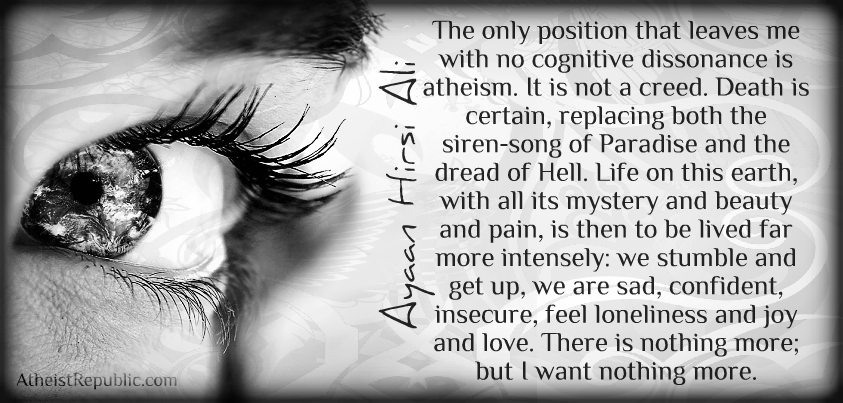
Doubt is the bedfellow of fundamentalist belief.
Churches push “faith” to counter people questioning belief; yet a rational thinker knows faith is never a satisfactory explanation for anything. Faith always causes cognitive dissonance, an uncomfortable mental state in which ideas are at odds with each other.
Cognitive dissonance is an unpleasant niggling source of anxiety, which many Christians try to avoid by ignoring facts and repeating Christian creeds. This does not work for them. No matter how loudly one sings “silent night,” the virgin birth is still absurd.
Consider Christian parents who deny their son is homosexual. They may tell their boy that God did not make him that way, that they will pray for him, or they might threaten him with God’s retribution. These actions might, in fact, wreck their relationship with their son, and will not change his inclination. If, on the other hand, they took the time to learn about the nature of homosexuality, they might accept his orientation, and have a loving relationship with their boy.
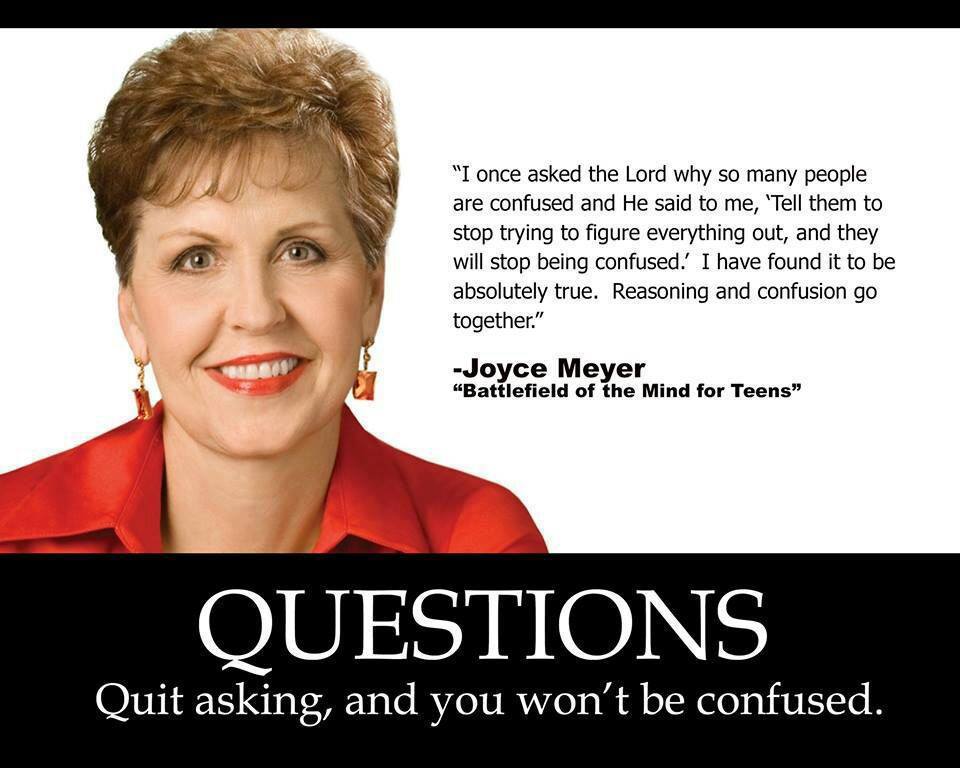
Power in Families
In the Bible, people are ordered to obey God, and punished if they do not. In Ephesians 6:1, Paul states that children should obey their parents, as if it were a universal and infallible truth. It is no surprise that some Christian parents abuse their power.
Smart parents know that good parenting requires thought and work. Interactions with children need to be perceptive, individualized, and developmentally appropriate. Fundamentalist parents often avoid making the necessary effort. Rather, doctrinal rules chosen from an ancient, obsolete book are applied, and fear of punishment used for control. The family is deprived of the constructive process of developing standards and values. Children, lacking a role model, fail to learn how to make informed choices about their own life issues.
Physical and Sexual Abuse
 Physical punishment is sanctioned in the Bible:
“He that spareth his rod hateth his son: but he that loveth him chasteneth him betimes.” (Proverbs 13:24, KJV.)
Some parents take this to extremes, believing it is necessary to break the will of their children to gain their respect and obedience. This dictatorial attitude is typically patriarchal, and Paul’s mantras on women and children are used for justification.
Some fundamentalist wives fail to make a stand against abuse from their husbands because of Biblical beliefs about marriage and sex-role stereotypes.
 Sexual abuse occurs in many strictly religious families, for a number of complex reasons. It can be argued that fundamentalist beliefs may inhibit emotional development and compromise communication skills, which undermines natural adult-to-adult sexual intimacy. This may be why some adults turn to children for sexual gratification. This fits with the fact that pedophiles are often emotionally immature. The fundamentalist mother is less inclined to report the father’s behavior due to her subordinate status.
Children in strict fundamentalist families are told to be obedient and to revere their parents, especially their fathers, so they are more vulnerable and less likely to seek help.
Lack of Critical Thinking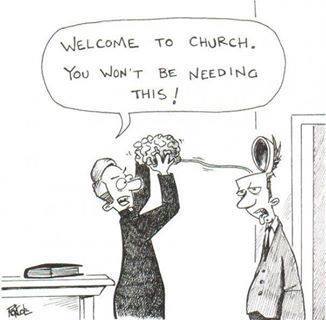
To be truly happy, it helps to exercise critical thinking skills. Curiosity is a natural instinct that helps people learn about the world. Even the most long held beliefs should be questioned. Yet people in Churches are often discouraged from being inquisitive, an attitude that originated from the Bible. Adam and Eve were ejected from Eden because they ate of the tree of knowledge. Paul wrote,
“Where are any of ou r thinkers today? Do you see now how God has shown up the foolishness of human wisdom?” (1 Cor. 1:20, JB.)
Church services are usually a one-way stream of information going from the preacher to the preached at. God has already done the thinking, and provided a package of beliefs that must be adhered to. Independence, and new ideas, are for fools.
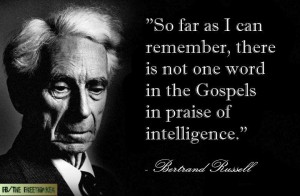
People in Churches are told that faith is superior to thought. This can cause them to perceive it wrong to examine any new idea. For example, many believers are wary of new technology, reluctant to take medicines, or change their diet. They are not open to innovation because they have been robbed of the confidence to think! [9]

Sexuality
 The human body, which is the very essence of what and who we are, is not respected in the Bible. Sexuality is denigrated, the “flesh” is evil, passion is sinful, and one’s libido is impure. Health, beauty and physical pleasure are distractions from belief in God.
There are no prizes for guessing who promotes these noxious ideas:
“This I say then, Walk in the Spirit, and ye shall not fulfil the lust of the flesh. For the flesh lusteth against the Spirit, and the Spirit against the flesh: and these are contrary the one to the other: so that ye cannot do the things that ye would” (Gal. 5:16–17, KJV.)
“Now the works of the flesh are manifest, which are these; adultery, fornication, uncleanness, lasciviousness, idolatry, witchcraft, hatred, variance, emulations, wrath, strife, seditions, heresies, envyings, murders, drunkenness, revelings, and such like: of the which I tell you before, as I have also told you in time past, that they which do such things shall not inherit the kingdom of God.” (Gal. 5:19-21, KJV.)
Poor old Paul was profoundly anally retentive, unable to drop his guard and relax. He viewed the world through the distorted prism of his own unhappiness.
If a person’s libido, which is healthy, instinctive and natural, is suppressed, it is easier to control them. Sexual energy can be diverted into obsessive-compulsive piety and harnessed for the purposes of the Church.
All of us are sexual beings, yet the victims of a Christian upbringing often display circumspection, disdain, or even an outright rejection of their own sexuality. There are some predictable results, such as self-loathing, denial over sexual orientation, guilt, loneliness, anger, regret, and failed or frigid relationships. Doctors, psychologists and social workers are often left to pick up the pieces after the damage has been done. I have many patients, particularly older people, who have sexual problems and broken relationships due to their Christian upbringings, and it is sometimes very difficult to help them. How tragic and unnecessary!
Some fundamentalist Christians have an obsessive preoccupation with other’s sexual preferences, thereby externalizing their own inner battle against sin. A classic example is a noisy preacher, himself a closet homosexual, babbling on about the evil of being gay.
Religion Replacing Love
There is nothing more crucial to a child’s emotional development than the love freely given by parents and family.
Some fundamentalist Christian parents, not good at expressing love, or even affection, use religion to compensate for what is lacking in their own repertoire of parenting skills. They use prayer as a substitute, presuming their children will benefit from a “personal relationship with Jesus,” and in doing so push their own children away. Children feel rejected, as they assume they are not good enough for their parents. The Christian faith is at fault, because it over emphasizes the relationship with God or Jesus, and thereby downplays the importance of real interpersonal love.
As a consequence, fundamentalist families can be unaffectionate, lacking fun, confidence, spontaneity and laughter. There is not enough “realness” and self-confidence to freely give the hugs, compliments, and unconditional love that children so desperately crave and need. Individuals become burdened with self-esteem issues and difficulty expressing affection for others, and grow up to be dysfunctional adults.
Intolerance
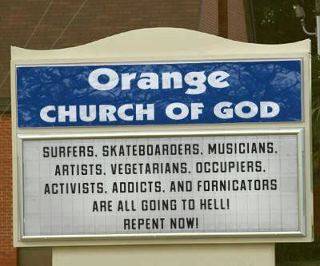 In the New Testament it is repeatedly stated that one must believe in Christ, and outsiders who do not are evil and will burn in hell. Is it any wonder that fundamentalists think the best advice comes only from their God, and this God only likes Christians? The smug Christian may think that he can ignore humanist appeals for tolerance of other religions and atheism.
Most moderate Christians have distanced themselves from this type of thinking, yet it still poisons plenty of personal relationships, as well as international relations.
Uncertainty
 According to the Bible, God has a plan for everyone, and all of life’s events have a divine purpose. As humans live in a sometimes cold, unfriendly and unfair universe, some Christians think that God lets terrible things happen. They ask questions.
“Why did I lose a parent to cancer?”
“Why did my friend commit suicide?”
“Why did a little girl get run over?”
“Why were people killed in a tsunami?”
“Is God angry? Am I being punished for not having enough faith or for having wicked thoughts?”
 God never answers because he does not exist. Patronizing platitudes promoted by preachers about “God’s plan” only add insult to the pain.
Rather than imagine there is an omnipotent man in the sky controlling everything, is it not better to accept that the world is sometimes harsh and unfair, and there is no moderator who will one day even things out? Anger about injustices might then soften into grief. Reality dawns: people are flawed, and always will be, and things occur due to unforeseen circumstances, so shit sometimes happens.
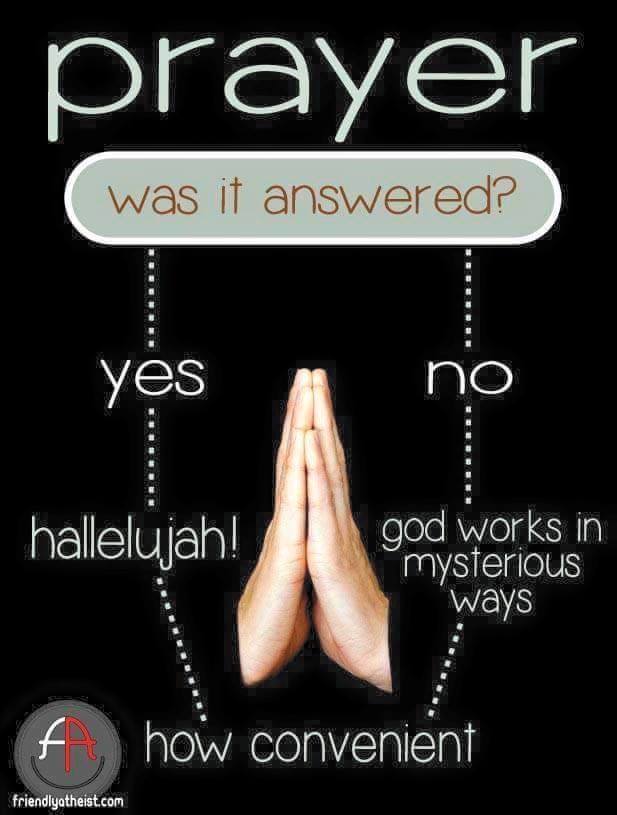
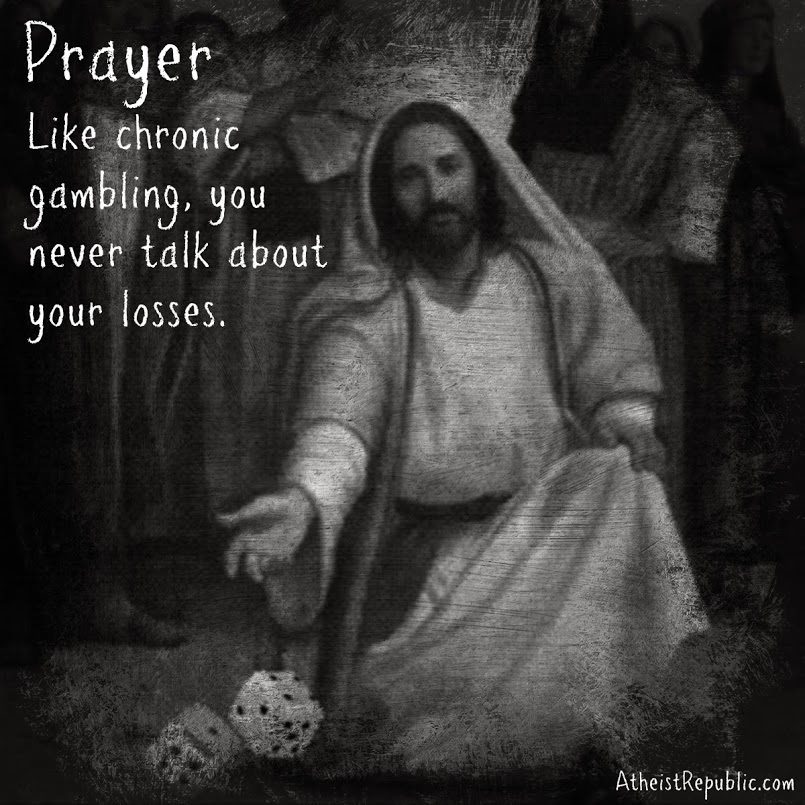
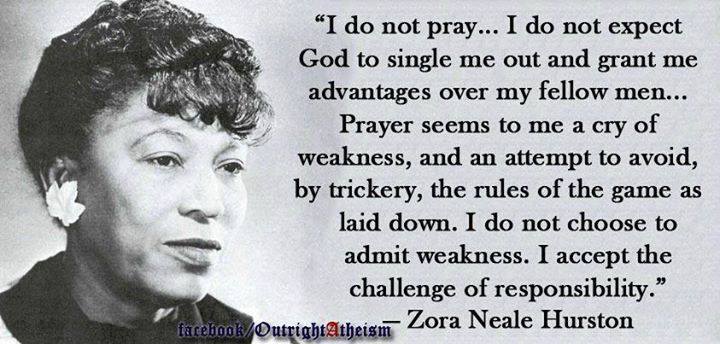
 Prayer is pointless. The idea that the laws of nature and the vagaries of chance respond to wailings and incantations is pathetic. Instead of cowering before an imaginary master who moves in mysterious ways, people should analyze what went wrong and why to help prevent a repeat. That means putting thinking caps on and asking for help from our fellow men, who, unlike God, will answer back. That is productive and empowering. Praying is not.
Complacency
Some lazy Christians find it easier to ask God to work on their personal problems rather than find solutions for themselves. Relationships with loved ones can be left in limbo because of the belief there will one day be an eternity to spend with them, and serious issues may be left unresolved.
The true believer may neglect to look after their appearance or health because they fancy all will be fixed when they meet their maker.
Too many people never realize their true potential because they are dreaming about what they think will happen when they die, so neglect to do their best in the here and now.
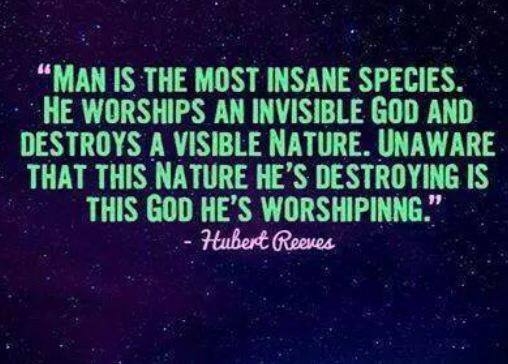
Some Christians do not respect the earth because they believe one day God will restore all things ruined. Or they think the planet will one day be destroyed in a massive cataclysm, so why bother preserving it now? Yet all of us have a moral obligation to give future generations a clean environment.
“Un-Christian” Emotions
In many fundamentalist communities, emotions such as anger or frustration are not allowed expression. People are told to pray, a poor substitute for giving them the chance to express what they feel. “Emotionality” is suspect, and there are always “higher” concerns than personal feelings. Many people struggle to reconcile their need for recognition with an acute feeling of shame whenever they are the focus of attention. They avoid expressing their feelings until the point is reached when emotions boil over. Then there are explosions of anger or frustration, followed by intense feelings of guilt, but a reluctance to talk about issues. The cycle is often repeated, producing deeply emotionally scarred, angry, poorly self-expressed people.
I acknowledge the following sources, from which some of the above information was derived:
– Merle Hertzler’s website,[10] and
– Marlene Winel’s book Leaving the Fold: A Guide for Former Fundamentalists and Others Leaving their Religion.[11]
Benefits?
Some Christians give credit to Jesus for better marriages, a happier family life, improved relationships and stronger characters. They claim Christians are less likely to suffer from anxiety or depression. I have not found any objective evidence for these assertions. My own (admittedly anecdotal, and possibly biased) experience in medical practice suggests the opposite.
Some Christians claim their beliefs will help them face death. Yet more often than not, when people are dying or bereaved, they discover how utterly hollow and disappointing Jesus’ empty promises really are. I have looked after many Christians as they are dying, and they rarely talk about Jesus.
When the world is cruel, if someone loses their friends or family, there is always one last person to turn to who might, in a second rate way, make you feel loved; Jesus. Skim through a book, repeat a few prayers and accept a friend request from the invisible man. He does not hear your problems, or answer back, because he is dead, but the hope he might somehow still be listening may be better than nothing. Average Joe might tell himself he is special, a shining light, but that is only in his own imaginary world, and deep down he is still lonely. His new best friend, Jesus, is a statue in a church, and a character in a book, not someone that can give the tiniest piece of real help. It is not surprising that Joe never feels quite like the winner he is supposed to be.

Joe gets to pray, which may be a half useful type of meditation; a conscious effort to take time out. Yet prayer is just talking to oneself. Joe admits his sins, which is just crystallizing what is bothering him, and he half clears a guilty conscience by confessing what he regretted doing, yet he rarely addresses the reasons he did what he did. He asks forgiveness from an imaginary magician, thereby side-stepping the path to self-improvement, and he does nothing to repair the relationship with the person he sinned against.
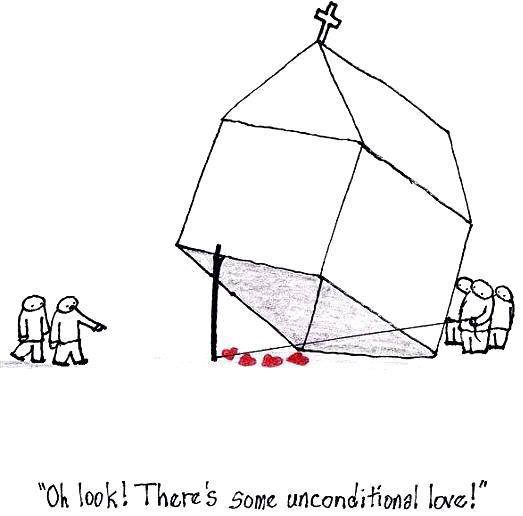 It is sometimes claimed that life is given meaning and purpose for those who belong to a Church. That might be true, yet it may suggest more about the individual than the Church. For many people their Church may be the one place they know they will always be welcomed. That is a good thing, provided they find some genuine person to person contact in Church, which does not always happen, and provided they are not discouraged from finding friends elsewhere, which sometimes does happen.
Christians are told to love each other, but people do not love others just because they are told to. This maxim degrades the meaning of real love. There is often a superficial friendliness in Churches, which is a step in the right direction. Yet many Church congregations are full of cliques, and too often Church people delight in gossiping about, judging and backstabbing others. It is as if they imagine God is judging everyone, so they give themselves the right to get in first with their own opinion.
It is often true that the real humanitarians, people who are genuinely good at getting on with others, are doing just that, and not wasting their time in Church.
There are sometimes social positives associated with Christian groups. Churches can provide people with a structure in which to care for others. The Salvation Army, the Red Cross, and Saint Vincent de Paul do genuinely help people. So do good priests and pastors, often in smaller churches, who express their humanitarianism through religion.
There can be a sense of belonging in Christian groups. Yet people can get that from secular groups, without the mythology and outdated ethics. Despite the claims, God’s, Paul’s and Jesus’ teachings, taken as a whole, do not promote social harmony. Those who imagine they do have not read their Bibles objectively. I think that if good things happen in Christian communities, it is despite Christianity, not because of it.
[1] http://awaypoint.wordpress.com/2013/03/26/religious-trauma-syndrome-is-it-real/
[2] http://atheism.about.com/od/pentecostalism/a/AnxietyDepress.htm
[3] http://www.ex-christian.net/topic/43559-fundamentalist-christianity-and-clinical-depression/
[4] http://www.washingtonpost.com/wp-dyn/content/article/2007/09/04/AR2007090401625.html
[5] http://www.youtube.com/watch?feature=player_embedded&v=ElfyYA420F0
[6] http://www.youtube.com/watch?v=T69TOuqaqXI&feature=autoplay&list=PL85F1EE32A438AEB8&playnext=2
[7] http://www.youtube.com/watch?v=2m9SRbjEHrY
[8] http://www.youtube.com/watch?feature=player_embedded&v=Wgj65-EfmoA
[9] http://www.youtube.com/watch?v=6OLPL5p0fMg&feature=bf_prev&list=PL85F1EE32A438AEB8
[10] http://webspace.webring.com/people/xq/questioner/mhealth1.htm
[11] http://www.amazon.com/Leaving-Fold-Marlene-Winell/dp/1933993235/ref=sr_1_1?ie=UTF8&qid=1352717373&sr=8-1&keywords=marlene+winell



As our Aryan portrayal of the Messiah comes to a screeching halt, I often hear an emotional response from white Christians.
Fulton postulates that in the fourth century, when militant Jews were no longer a threat, the Roman government under Constantine realized that Christianity, with its ecclesiastical hierarchy, could prove a useful ally when it came to crowd control.
Mark Fulton’s book Get over Christianity by Understanding it questions the origins of Christianity through an exploration of who the Biblical players were, and the authors’ motives.
Your use of a patient’s letter to back up your argument is utterly disgraceful and unethical, as is the obvious delight you take in mocking her. It’s a wonder there’s room in your surgery for you, your patients, and your massive ego.
My ego is not that big. The letter was generic, not personal. I didn’t mock her.
I no
Longer practice abrahamic religion. It destroyed my life. I am 64 and a man married to a very good man. My problem is family who do not recognize my very legal marriage. Performed by a civil magistrate in a city hall. No God was at my marriage, thankfully. What is the best way to handle these people. For now I disowm them.
I left Christianity a few years ago and have never looked back, although I’m having a very difficult time overcoming some of its belief systems, such as the power of prayer, the existence of angels, God, Satan, heaven, and hell, and so on, so I guess I haven’t completely freed up my mind, although I really want to. And because I’ve always felt sexually attracted to other women, I learned to hate myself for being gay because almost every church I belonged to has preached against it saying that all homosexuals are going to hell, and a couple of churches have even tried converting me out of my sexual orientation, which only made my desire for other women even stronger. Today, I am a gay woman still struggling with my Christian beliefs as well as my sexual orientation, I am trying to be spiritual in my own way, and I no longer know or even can trust what is true and what is considered false because there is so much conflicting information out there and so many different sides claiming that there right and everyone else is wrong, so I’ve just decided to stay put in the middle and only agree with what makes the most sense to me and try to live accordingly. It’s all I know how to do. I am also trying to be a free-thinking nonconformist who just wants to spread her wings and do only what works best for me. Christianity is very, very dangerous, and because of its religious indoctrination of children, it needs to be outlawed and forced underground all over the world. Children should be free to think for themselves. Women should learn to take control of their own bodies and minds and become empowered. And mankind should learn to rely on his own human powers rather than pray and sit and wait for something to happen. I want to live in a world where we are all free-thinking secular humanists out to make our planet a better place for others, where we don’t use religion as a way to control others. A freer, happier, safer world for all.
Thankyou for sharing this. It is beautiful.
An excellent essay, well-written and trenchantly argued.
Thankyou Ken.
It is particularly nice to receive an encouraging comment from a well known scholar and fellow atheist. I have learnt a lot from your website at http://www.jesusneverexisted.com, and your videos on YouTube.