

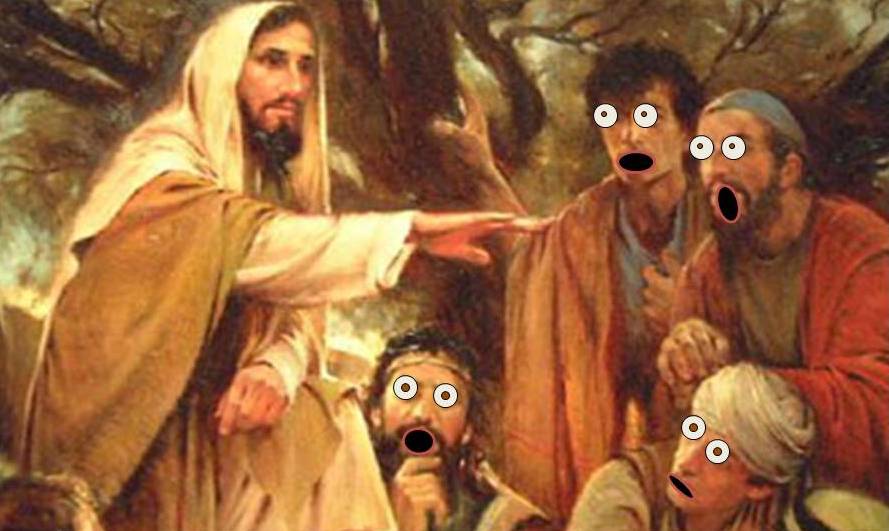
Jesus and Hell
 Gentle Jesus, meek and mild, said,
“But woe to you, scribes and Pharisees, hypocrites!…woe to you, blind guides…You blind fools!…You blind men!…You serpents, you brood of vipers, how are you to escape being sentenced to hell?” (Matt. 23:13–34, NJB.)
“Well then, just as the darnel is gathered up and burnt in the fire, so it will be at the end of time. The Son of Man will send his angels and they will gather out of his kingdom all things that provoke offences and all who do evil, and throw them into the blazing furnace, where there will be weeping and grinding of teeth” (Matt. 13:40–43, NJB.)
“Next he will say to those on his left hand ‘Go away from me with your curse upon you, to the eternal fire prepared for the devil and his angels’’’ (Matt. 25:41, NJB.)
Jesus was convinced of the reality of hell, and threatened people he disliked with damnation. His threats raise five key issues:
First, he would have had no need to intimidate people if he had made a convincing case for himself. The implication that those who did not agree him would incur retribution (argumentum ad baculum, or literally an “argument with a cudgel”) means he resorted to intimidation after he had failed to convince his listeners. It is probable that Biblical authors were browbeating people who balked at joining their new cult.
Second, Jesus claimed that the love of the divine arbitrator was only granted to those who behaved. Most people today say that true, real love, such that a parent often has for a child, is unconditional. In Jesus’ scheme, God is a petty, vindictive dictator who threatens his own creation with conditions. God is hardly the loving character he is made out to be.
Third, these quotes confuse Jesus’ doctrine. He advised people to love their enemies, bless those that curse them, and forgive seventy times seven times, so he hardly set an example by blackmailing people with threats of hell.
 Fourth, one wonders on what basis God decides who goes to hell? There must be borderline cases. Some Christians claim that people choose hell by “rejecting Jesus.” What does that mean? What about those who have never heard of him? Some state we have to “accept Jesus” to avoid hell. “Accepting Jesus” means being compliant. Church people know how to create, then calm, newcomers’ fears—mention hell and then convince them to embrace Jesus and conform.
Fifth, it is highly unlikely that the real Jesus, who would have been a dyed in the wool Jew, would have believed in hell. Jews never have, and still do not, preach about such a place. The Old Testament does teach that there is life after death, specifically that every single soul goes to a graveyard called Sheol. (http://www.jewishencyclopedia.com/articles/13563-sheol). The wicked are there (Ps. 9:17, 31:17, 49:14, Isa. 5:14,) and so are the righteous (Gen. 37:35; Job 14:13; Ps. 6:5, 16:10, 88:3; Isa. 38:10.) It is not somewhere a soul is sent if it has behaved badly. “Sheol” is sometimes incorrectly translated as “hell” in the Old Testament. Yet Sheol is a proper noun, so is a name or title. It should not be translated but simply transliterated, as is done with other names. The literal meaning is simply “subterranean retreat.” Anything more is conjecture and speculation.

Many church people still preach hellfire to children who do not have the maturity to realise it is nonsense. Right now, there are children lying in bed trembling at the idea that the devil wants to drag them to Hell. This is psychological bullying, nothing less than child abuse.
Some adults still have vivid childhood memories of being terrified by the immense, unending pain in hell, and still shudder when they think of such a place.
In the past, Churches used hell to justify terrible behavior. They thought it gave them license to burn any helpless person they did not like; that they were just beginning the roasting, on earth, that Satan was to continue for all eternity.
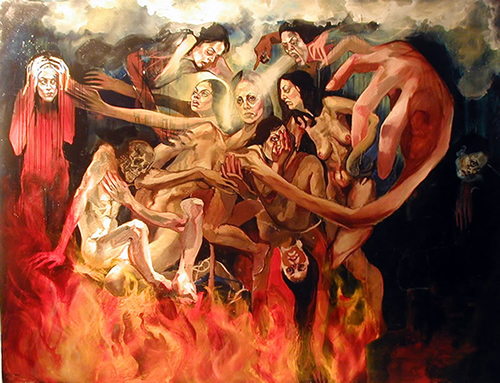
Purgatory
For centuries the Catholic Church preached about purgatory, a holding pen where sinful, but not really sinful Christians will find themselves after death, where fire might wash them free of sin. It was like a half way house to hell.
The popery procured vast profits by selling indulgences to vulnerable bereaved people in the belief the money would let loose their loved one’s soul out of purgatory. The living, filled with anxiety for their deceased relations, paid the Church so the recently dead would move more quickly through to heaven. What a scam! With a credulous populace, it was a license to print money. This contemptible practice became one of the triggers for the reformation.
To preach the concept of an eternal punishment to vulnerable people is immoral. It is a convenient one too, as the idea threatens a postmortem punishment that the Church itself never has to enforce. Just like heaven, noone has ever come back from the dead to prove it is all true. It is a very easy way to make susceptible people compliant without consuming resources.
Hell is quite rightly an embarrassment to many modern Christians, who choose to ignore Jesus’ words by not talking about this ancient/medieval mandate any more.




http://www.youtube.com/watch?v=A1Si425yfNc&feature=related

There is something very very wrong with people who are ok with the notion that their child might end up in hell.
I did live in a constant terrible fear of hell prior to rejecting christianity. Like you rightly stated ”To preach the concept of an eternal punishment to vulnerable people is immoral”. In addition, I sought this ”Jesus’ to reveal himself to me, but to no avail. My many prayers went unanswered and I was constantly tormented by the presence of terrifying unseen entities, I guess the ones I had been schooled about that exists. This Jesus never showed up . After rejecting christianity and this Jesus, my life has returned to normal.
Thankyou for sharing. There are many like you, I’m pleased you are back in reality.
Thanks a million for this article. I rejected christianity nine months ago after 23 years.I earched earnestly for the truth and found the bible and christianity have zero evidence for a god-man. Beside, the book is filled with errors and contradictions that defy belief.
Jesus is as real as satan, but JESUS is LORD, and satan is tide up like a dog with chains,LOL and Blessed be Our Mother Virgin Mary who defeated satan. I will pray for all evil, satanist, and all atheists.
“Jesus is as real as satan” Yep! Neither of them exist.
this Page is full of it, There is a Heaven, Purgatory and a Hell, its not made up by THE CHURCH, Real Church is The Catholic Church, satanist even know this for a fact, satan has no authority, he has to ask GOD the Father for permission to do something, May God Bless whoever reads this
There is no proof for any of your claims.