

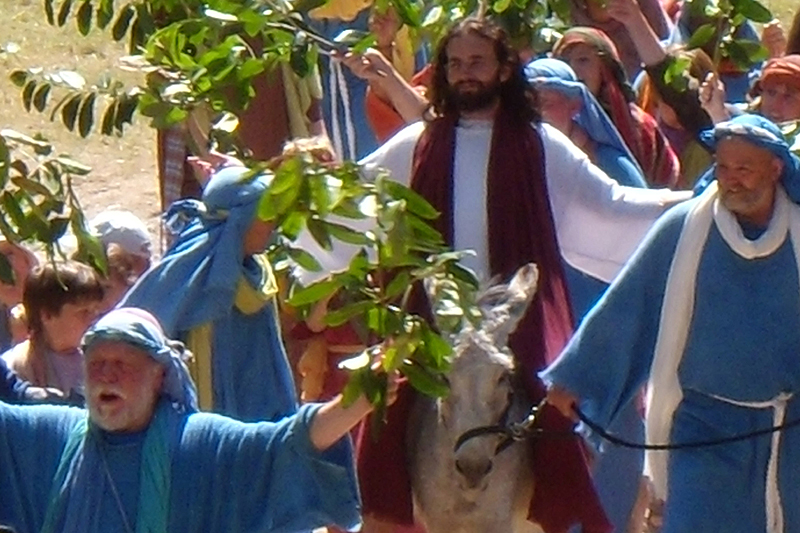
Jesus Enters Jerusalem and starts a Racket
Toward what was to be the end of his campaign, Jesus focused on Jerusalem. It was the political, economic and spiritual center of the Jewish nation, and boasted a large Jewish population that swelled exponentially around Passover. If Jesus was going to begin an insurrection against Rome, it had to start there.
According to the Gospel of John, he preached by day at the temple and retreated to a safe house at nearby Bethany before nightfall.
Jesus was anointed with oil. The word “Messiah” means an anointed one, as does the name “Christ.” So the name Jesus Christ is referring to Jesus, the anointed one. In the Old Testament, to anoint someone was a one-time event that specifically selected the person as a king or a high priest (or maybe a prophet.) Jesus wanted to be a king. By being anointed, he was publically accepting his post as the messiah, the king of the Jews.
Passover was an annual commemoration of Jewish freedom at which the city accommodated 300-400,000 pilgrims. Roman authorities were on their guard against civil disobedience. Pilate, the Roman governor, always attended to keep an eye on things. Roman soldiers were outnumbered by something like one hundred to one. The event was a tinderbox that could catch alight given the right spark.
When Jesus allegedly rode on a donkey into the excited atmosphere in Jerusalem on Palm Sunday, throngs of jubilant Jews greeted him, so the Romans must have known he was coming. He effectively broadcasted his intentions to the crowd. Pious pilgrims were expected to walk into the Holy City, so he was deliberately doing his best to stand out from the rabble by riding. The son of David had surfaced and was staking his claim! He may have been trying to fulfill a prophesy from Zechariah, who wrote,
“Rejoice heart and soul, daughter of Zion! Shout with gladness daughter of Jerusalem! See now, your king comes to you; he is victorious, he is triumphant, humble and riding on a donkey, on a colt, the foal of a donkey” (Zech. 9:9, NJB,) assuming, of course, a Gospel author did not retrofit the donkey part of the plot into the story.
Yeshua must have known that to play the part of a king was an act of treason against Caesar, and punishable by death, yet he did it right under the noses of the Sadducees and the Romans. It was a move made by a brave man. It could have been a calculated lampoon of the entrance one would expect from a Roman emperor. I think he was taking a gamble, guessing he would not, or could not, be arrested because he was so popular with the people.
I think he was hoping to enlist the support of the Jewish revellers in Jerusalem, and with their help overpower the Roman garrison and thereby launch a full-scale rebellion against Rome. This was quite an ambitious agenda, and he would have been well aware of the risks, yet encouraged by the hope that his God was going to help him.
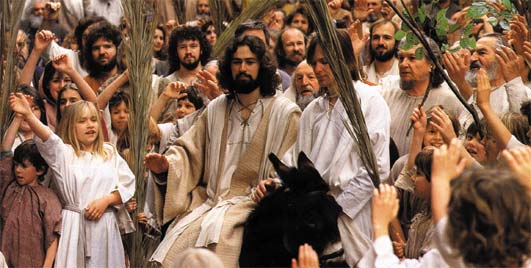
Matthew claimed the crowds in Jerusalem hailed him as a hero:
“Great crowds of people spread their cloaks on the road, while others were cutting branches from trees spreading them in his path. The crowds who went in front of him and who followed were all shouting: Hosanna to the Son of David! Blessings on him who comes in the name of the Lord! Hosanna in the highest heavens! And when he entered Jerusalem the whole city was in turmoil. Who is this people asked, and the crowds answered, this is the prophet Jesus from Nazareth in Galilee” (Matt. 21:8–12, NJB.)
“Hosanna” was a Jewish exclamation welcoming someone who “saves.” It was a cry of independence. The spectators were saluting the son of David, a legitimate Jewish king.
Luke wrote,
“Some Pharisees in the crowd said to him, ‘Master, check your disciples,’ but he answered, ‘I tell you, if these keep silence the stones will cry out’” (Luke 19:39–40 JB.)
It sounds like Jesus put on a persuasive performance. He proved himself plucky and purposeful, just like a real ruler. The crowds bought it, and were excited. The whole city was in turmoil. This was a high point in his career and he would have been flushed with excitement. Everything was going to plan.
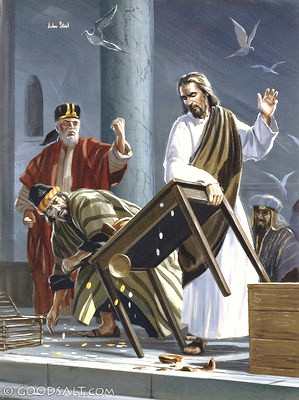 The next day he went to the temple. This was where fees were to be paid to the priests, and to the moneychangers who exchanged Roman coinage and Jewish currency. It was also where money was collected to pay for the places that offered ritual bathing, for the actual animals, and for the priests to kill them. There was rent to be collected from the hoards of visitors who had to stay over-night, and fees for feeding them. The priests had engineered things so that the temple was where all this happened. Yeshua was clearly compromising all this by turning the tables over, causing a ruckus in a city centered on, and devoted to the temple-based economy.
He must have had a crowd of Jewish supporters to cheer him on and protect him. There were no Roman soldiers allowed in the Temple, so to arrest him on the spot would have been difficult. To start a scene in the temple and test the authority of the Sadducees was making another affirmation that he had arrived. It showed he was willing to be aggressive to achieve his aims.
That night he returned to a safe house at Bethany, yet Luke’s account makes it clear that Jewish authorities had him under surveillance.
The next day he again provoked the Temple hierarchy by debating them in public. Matthew had Jesus state that what belonged to Caesar should be returned to Caesar (Matt. 22:21;) in other words that Jews should pay taxes to Rome. I think this was written in to derail readers from reaching the conspicuous conclusion that Jesus was a zealot. It makes no sense to imagine that a man who turned over tables in the temple and thought he was king of the Jews would pay tax to a Roman Caesar.
 The atmosphere in Jerusalem must have been tense. Something definitive was bound to happen soon; one of the sides was going to pick up their weapons. Consider the principal players in the evolving events.
On one side was Jesus, who was convinced he was a king and the messiah of Israel. He had been emboldened and protected by a show of support from a pepped up Jewish populace. He was now under pressure to play his hand. At this critical time, tactics were everything. He knew there had to be a fight, but how and when to start it? He may have been waiting for divine help from Yahweh, whom he knew had helped previous prophets win wars, because that was what was written in Scripture.
On the other side were the Roman army and the chief priest, the Sanhedrin and their associates. Pontius Pilate, who contemporary historians described as dictatorial and violent, supervised the soldiers who were on their guard, organized, trained, and in fine fettle. Jewish leaders knew Jesus was hoping to start a revolt. They were powerful men supported by Rome and the last thing they wanted was a zealot stirring up the people. An insurrection would threaten their positions and even their lives, because the Roman garrison couldn’t protect them from thousands of hotheaded Jews. They had to act quickly and decisively to prevent Jesus gaining the upper hand. A conflict was inevitable. The stage was set for a showdown between Rome and what Jesus believed was the true Israel.

Great post. I am facing a couple of these issues.
“Get over Christianity.” The only thing to “get over” is your own arrogance, naivete – and prideful, sinful heart.
The Passion week played out exactly as it was meant to. God was fully in control of the events. Jesus was meant to die from the beginning, for us. For you.
None of the events were a surprise to Him, or to Jesus. Only to His followers who of course did not fully understand what was taking place before them.
For some to post “if Yeshua existed” only displays their own ignorance, and lack of desire and effort to even know Truth. The historical and archaeological evidence is overwhelming, even to the non-Christian of their time, and our time. At least those who are willing to seek the evidence, and honest with themselves about its clear existence.
Its sad that such misguided writings and claims exist, but not at all surprising. Jesus plainly spoke of folks such as you, often, during His time here. Make no mistake. You ARE misguided. Seek Him with an open heart, and you will know Him, and know Truth.
You have no evidence for your claims. I have written a book about mine. You should read it.
This article is alot of BS.
Several things I gotta point out-
a. Jesus was not trying to start a revolt.
Jesus was a peaceful man, and never called for a revolt against the authorities. In fact, he prohibited his own disciples from attacking the soldiers who came to arrest him. He willingly.
You are mislead to think his intention was to start a revolt.
The poorer classes must have dreamed about a Messiah who might make their lives so much better. It is not hard to imagine that any charismatic Jew brave enough to claim he was the Messiah could soon collect a gang of Galilean paupers to back him up, particularly if he was said to be David’s descendant. A young Yeshua must have wondered who this Messiah was going to be.
As most Essenes were celibate, Yeshua may not have had a family of his own. Nor would Yeshua have been bothered with accumulating wealth. He was a man with an altogether different agenda.
Most young men are irked by any imposition on their freedom. If they are poor and have little hope for a positive future, their frustration escalates. In most cultures, identity and self-respect are aligned with religious and ethnic affiliation. Bad feelings against foreigners boil over if these features of identity are com- promised. Picture young Arabs in the Gaza strip for the modern equivalent.
Yeshua was young, poor, oppressed, and almost certainly a religious idealist.
If something swims in the sea, in a school of fish, looks like a fish, and gets caught on a hook, that something is a fish. Yeshua was part of the underdog class, and lived in a time and in a place that was a hotbed of political unrest. Yeshua had the right pedigree to be a zealot; he talked, lived, and associated with zealots, and he was killed as a zealot, (discussed shortly) so the rational observer would be correct in regarding him as a zealot. A man in this context could have fashioned himself as the head of a gang of Galilean militants, a gang unified by their shared resentment of the fact that Romans were rulers in God’s holy land. Yeshua most likely made a career out of preaching about his political aspirations for Israel. There is much evidence for this in the Bible.
Matthew claimed that Herod the Great was perturbed that the baby Jesus might one day be king, so Herod had a lot of Jewish baby boys killed. Matthew wanted the reader to think that Herod considered Jesus a threat, and so Matthew was priming people with the idea that Jesus was destined to be their Messiah, the King of Israel. There is no historical secular evidence that this very unlikely scenario actually happened. Herod’s job was to keep the peace, not wreak havoc.
Jesus was closely associated with zealots. Simon (Yeshua’s brother) is twice named as a zealot (Luke 6:15,73 Acts 1:1374). Judas Iscariot may have been a zealot because the name “Iscariot” is cognate with the Latin “Sicarius,” a dagger-wielding zealot assassin. Simon Peter, one of Yeshua’s disciples, was known as “Bar-jona,” (Mt. 16:17) a name commonly given to zealots. James, another of Yeshua’s brothers, and John, one of his disciples, shared the nickname “Boanerges” or in Hebrew “benei ra’ash,” which meant “sons of thunder,” another well-known zealot reference.75 It is unlikely the Gospel authors invented these pro Jewish names, so they are probably genuine. This gives further weight to the argument that Jesus was a zealot.
Yeshua’s disciples would not have given up their jobs and families to tramp around the countryside to listen to platitudes. Life was too harsh and the times too cutthroat for that. It is far more likely that Yeshua and his disciples wanted to create a better life for themselves and their families. Young men two thousand years ago were just as brave, worldly and idealistic as they are today. These young Jews had been raised in a culture that worshipped their one and only god, Yahweh. They thought that Yahweh was on their side, and imagined he was offended by the presence of Gentiles in the holy land.
Consider Jesus’ attitude to violence:
“Do not suppose that I have come to bring peace to the earth: it is not peace I have come to bring, but a sword” (Matt. 10:34, NJB.)
Some Christians go to great lengths discussing what Jesus “really meant” when he said this, yet perhaps the quote is best taken at face value.
Consider Jesus’ attitude to the rich:
“Yes, I tell you again, it is easier for a camel to pass through the eye of a needle than for a rich man to enter the kingdom of heaven” (Matt. 19:24, NJB.)
In Jesus’ day most of the wealthy were in collusion with the Romans, a fact that probably greatly perturbed the Nazarenes.
After Jesus’ crucifixion, a follower of Jesus says:
“Our own hope had been that he would be the one to set Israel free” (Luke 24:21, NJB.)
To set Israel free could only mean one thing in first century Judea – to remove Roman rule.
The Gospels’ authors often portrayed Jesus as a zealot – a fact that can be read directly, and “between the lines.”
You would do well to be a little more open minded and to read “between the lines” when you read your bible. You might also benefit from reading some non biblical historical sources.
Jesus, or better, Yeshua, was brought up in a part of Judea that had a reputation for causing trouble for the Romans and their Jewish collaborators such as Herod. Nazareth, if such a place existed, was situated at the epi-centre of a major revolt that broke out following the death of king Herod, when Galilean freedom fighters captured Sepphoris and its well stocked arsenal. The eventual Roman response was brutal in the extreme. Sepphoris was recaptured, burned to the ground and its surviving inhabitants enslaved. Judas, the rebel leader escaped and went into hiding. Roman troops and their Arab auxiliaries ranged far and wide, burning, lootings and raping. The impact of this on Jesus as an impressionable boy must have been considerable and laid the foundation of his future as an opponent of the Romans, becoming, as the historian F. A. Ridley described him, a Jewish Spartacus, who headed a revolutionary movement against both the Roman Empire and its its “servile pensioners, the Jewish priesthood, the “hellenizing” Sadducees who ruled under the protection of Rome” (Julian the Apostate and the Rise of Christianity. (London, Watts, 1937. pp.76 & 78)
Agreed. If Yeshua existed he was most likely a Jewish fundamentalist zealot.